Sunday, April 29, 2012

Blame the prism

Why do we need prisms? because they are what make up our day to day lives.
Why do they exist? Because the greek had nothing better to do, but while we're learning about them let's get one thing out of the way.When you are trying to find the are of a prism, it is WAY different than the latteral area. Lateral is the area of ONE face of the prism. But many forget that and make the mistake of finding the entire area. I've made the mistake a f times to but...

About Triangles

They're annoying, really annoying. But when you get the hang of it they can be pretty useful. So here's why I bring them up, lately my geometry teacher has been out so we have been given review work.
Which means that instead of new material we will be going over old things.
So who remembers the rotations and reflections of shapes across a plane? It's pretty easy.
90 degrees is (x,y)--->(y,-x)
180---->(x,y)-->(-x,-y)
270--->(x,y)-->(-y,x)

That's what we've been doing in class. 

Sunday, April 22, 2012

Volume of a polyhydra

What is a polyhydra?
A prism that has a base which is a polygon.
So say a pentagonal prism, or a hexagonal prism.
you would use the formula

nas*h
    3

n= number of sides
a=apothem
s=length of side
h=height

why three? Because it's a three dimensional shape. 

How to find the volume of solid figures

What is Volume?
Volume is he amount of matter a prism or solid shape may hold. Luckily we are not studying chemistry so you do not have to worry about matter, only how much something may hold it. There are many formulas to finding the volume of shapes. The most common formulas used are the ones for rectangular prisms, cylinders, and pyramids.

Cylinders:


r= radius
h= height.

rectangular prisms:
Volume= lwh

l=length
w=width
h=height

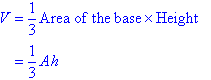
Pyramids;


Sunday, April 01, 2012

What is Lateral Area?

lateral area is the area of the sides of solid figures. Like a rectangular prism or a cylinder, when you unwrap it, the bases are off to the side and the faces are seen. To find these areas you need to keep the regular formulas to the solids, except you subtract the area of the bases from it.


How do we find the Surface area of Solids?

Solids are those annoying 3-dimensional shapes that you get on the Geometry regents and they give you a ton of formulas for but never the ones you need. So here are a few tips to help you remember the formulas for the more basic shapes.

Rectangular prism:

Now for this shape you will have to do a ton of more work. this is the shape that in 8th grade your teacher probably gave you the formula 2lw+2lh+2wh=the surface are (SA).

Well it is. The only thing is it ONLY works for RECTANGULAR prisms. This shape is pretty basic, the 'l' is the length, the 'h' is the height and the 'w' is the width.

Your next shape is a cylinder, this is one of the more easy ones, being that you already have prior knowledge of how to find the area of a circle. For this shape they give you the radius, maybe the diamater sometimes but that's okay. And the height of the radius. You multiply the radius by the height and you get your answer. Sometimes you will have to leave it in terms of Pi.

One of the more harder shapes is a pyramid. You need to know how to find the area of a regular triangle but you also need to remember that it's base is a square so it will need to be multiplied by some force (star wars re fence).

You need the are of one of the faces (the lateral area) and you will multply that by four (if it's a rectangular pyramid) So it will be 1/2*BH*4.


Sunday, March 25, 2012

Finding the area of a circle.

This is easy!!!!
The area formula of a circle is A=(pi)r^2
(I could not write the symbols down) 
It is so easy to do this. You need the radius, which is half of the circle's diameter. You need the value of pi, as well. So let's say if you got a circle with a diameter of 16, you will set up the formula like so.
A=(pi)8^2
A=(pi)64
A=64(pi)


And there is your answer!!!