Sunday, April 29, 2012

Blame the prism

Why do we need prisms? because they are what make up our day to day lives.
Why do they exist? Because the greek had nothing better to do, but while we're learning about them let's get one thing out of the way.When you are trying to find the are of a prism, it is WAY different than the latteral area. Lateral is the area of ONE face of the prism. But many forget that and make the mistake of finding the entire area. I've made the mistake a f times to but...

About Triangles

They're annoying, really annoying. But when you get the hang of it they can be pretty useful. So here's why I bring them up, lately my geometry teacher has been out so we have been given review work.
Which means that instead of new material we will be going over old things.
So who remembers the rotations and reflections of shapes across a plane? It's pretty easy.
90 degrees is (x,y)--->(y,-x)
180---->(x,y)-->(-x,-y)
270--->(x,y)-->(-y,x)

That's what we've been doing in class. 

Sunday, April 22, 2012

Volume of a polyhydra

What is a polyhydra?
A prism that has a base which is a polygon.
So say a pentagonal prism, or a hexagonal prism.
you would use the formula

nas*h
    3

n= number of sides
a=apothem
s=length of side
h=height

why three? Because it's a three dimensional shape. 

How to find the volume of solid figures

What is Volume?
Volume is he amount of matter a prism or solid shape may hold. Luckily we are not studying chemistry so you do not have to worry about matter, only how much something may hold it. There are many formulas to finding the volume of shapes. The most common formulas used are the ones for rectangular prisms, cylinders, and pyramids.

Cylinders:


r= radius
h= height.

rectangular prisms:
Volume= lwh

l=length
w=width
h=height

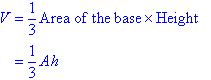
Pyramids;


Sunday, April 01, 2012

What is Lateral Area?

lateral area is the area of the sides of solid figures. Like a rectangular prism or a cylinder, when you unwrap it, the bases are off to the side and the faces are seen. To find these areas you need to keep the regular formulas to the solids, except you subtract the area of the bases from it.


How do we find the Surface area of Solids?

Solids are those annoying 3-dimensional shapes that you get on the Geometry regents and they give you a ton of formulas for but never the ones you need. So here are a few tips to help you remember the formulas for the more basic shapes.

Rectangular prism:

Now for this shape you will have to do a ton of more work. this is the shape that in 8th grade your teacher probably gave you the formula 2lw+2lh+2wh=the surface are (SA).

Well it is. The only thing is it ONLY works for RECTANGULAR prisms. This shape is pretty basic, the 'l' is the length, the 'h' is the height and the 'w' is the width.

Your next shape is a cylinder, this is one of the more easy ones, being that you already have prior knowledge of how to find the area of a circle. For this shape they give you the radius, maybe the diamater sometimes but that's okay. And the height of the radius. You multiply the radius by the height and you get your answer. Sometimes you will have to leave it in terms of Pi.

One of the more harder shapes is a pyramid. You need to know how to find the area of a regular triangle but you also need to remember that it's base is a square so it will need to be multiplied by some force (star wars re fence).

You need the are of one of the faces (the lateral area) and you will multply that by four (if it's a rectangular pyramid) So it will be 1/2*BH*4.


Sunday, March 25, 2012

Finding the area of a circle.

This is easy!!!!
The area formula of a circle is A=(pi)r^2
(I could not write the symbols down) 
It is so easy to do this. You need the radius, which is half of the circle's diameter. You need the value of pi, as well. So let's say if you got a circle with a diameter of 16, you will set up the formula like so.
A=(pi)8^2
A=(pi)64
A=64(pi)


And there is your answer!!!

How do we find the area of regular polygons?

Regular Polygons are just what they sound like. Polygons that are not bent or shaped weird. An example of a regular polygon would be the pentagon or a triangle. To find the area of these shapes you need the formula
A=nas/(1/2)

Which can be subtitused for A=pa

A is the are
n is the number of sides a shape has
a is the apothem, which is basically the radius of the shape (it is not for circles, so don't get it confused)
s is the length of the sides.

So let's say if you have a pentagon with an Apothem of 8, and side length of 7 you would set it up like so:

A=5*8*7/2 the result would be 140!

When you have the area but not one of the other variables, you must do the inverse operation.


Sunday, March 18, 2012

How Do we calculate the area of rectangles and triangles.

Rectangles and triangles are the easiest shapes that can be used to find the are.
Rectangles: B*H
Triangles: B*H/2

Triangles have to be divided by two since they are not full figures. This lesson was short, but only because it is so easy.


How d we solve are problems?

What is area?

Area is the measurement of a shape's insides. Different shapes have different shape measurements.There are many ways to finding the area of a shape.

If it is for a kite, the formula is (d1*d2)/2

"d" is the shape's diagonals. meaning the segments to the shape that are perpendicular to eachother.

Trapezoid: The trapezoid has two "bases" meaning two sides that are not congruent. You take both bases, the height and multiply them. The formula is (b1+b2)*h/2 Remember you have to divide by two at the end of it all.

Parallelograms are quadratic shapes that have similar sides but are not all congruent. The formula is simply b*h (Base times height). The height is never the slanted side!! 

Monday, March 12, 2012

How Do we Solve Compound Loci Problems

As I explained before, you already know what a Locus is, so there is no need for me to go into it.

But a compound loci problem is the easiest out of ll the locus problems. You are just plotting the points that it gives you. So for example if you have (2,4) as your point, the problem will ask you to plot a point 5 points away from it. You do not have to be a rocket scientist to count five spaces away from the original point. Once that it done make a circle that connects all the points. they have to be equally spaced, if not then you did something wrong.


Some questions will ask you to plot other points that satisfy the points. That just means to plot points that will be equidistant 9remember that word/) and that will break the circle with a line through it. That's all there really is solving Loci problems.


Finding area (of a triangle),

The area of any shape in the inside of it, which means that you will be finding the measurements of the shape's insides/ Do not confuse this for volume change, those are for three-dimensional figure.
The formula to find the are of any rectangle or square is A=BH
(Area equals base multiplied by the height). Though it is different for Triangles. Since some triangles are half of a square, the formula is A=BH(1/2)
(Area equals base times height, divided by half OR two). It is easier to remember this because you have to divide the new area by two which gives you the new area. Remember to always divide.

Doing the inverse.

Sometimes a problem will ask you to do the inverse operation meaning that you will be trying to find another variable to the problem. So instead of locating the are, they will already give it to you and you will have to find the base or the height.
So if the area of a shape is 14, the base is 2. Then you will multiply two by 14, giving you 28. Then you divide two (which i the base) by 28 and your height is 14!

A trick is you should always remember to multiply by two first so you will not get confused.

Later days!

Sunday, March 11, 2012

How do we find the locus point.

It's locust like the bug (those are gross)
Locus is the term used in a specific geometrical way to describe the points that satisfies a condition where ever it is along a circle, or a line.

I know, what does that all mean?

To put it into easier terms it means that you will be finding a point along line or a point that represents a general circle. Here are a few Key terms you will be using.

"Equidistant": This means that the point or spot you will plot, will be equally distributed between a line. Meaning, it;s basically the center of a line that cuts it into two equal halves.

"Two Fixed Points: A line through the middle of a point, a perpendicular bisector.

one Line: Two parallel lines on opposite sides of the original line

One Point: This forms a circle. (Watch out for it)

two intersecting lines: Two lines half way between the two original lines. .

Basically, Locus is all those terms I just spat at you up there. There are times when you will need to find the specific locus the problem is talking about. For instance, if the problem says that the original point is the origin (0,0) and that it's points must be 3 units away, you plot 3 units away from the X and Y axis. It will give you a circle, and that it your locus. They get easier as you continue. One problem is when they ask you to locate the point that satisfies the condition,.

Sunday, March 04, 2012

Conditionals

What are they? The annoying little word problems that make math all the more fun! Conditionals are when sentences (terms) mean something true but when changed (inverse). They're things are called logic.
Logic is basically common sense. If something makes sense one way it probably is true. Except in math there are different types of logistics. First you have to know the proper language, when words are flipped to mean the same thing, they are called contrapositives.
So something like "If today is Tuesday then tomorrow is Wednesday." could be switched too "if today is not Wednesday, it must be tuesday."
Easy right?
Next is inductive reasoning. That just means its there in the answer.
"Mary's mom has four kids, April, May and June. Who's the fourth child?"
Mary duh.

There are also conjunctions which are the words that make up statements, (we watched an entire school house rock video to it in class) and they are "if, then, are, but, nor, or,"

Those are the properties to logic. Next step is solving logic problems.

Sunday, February 19, 2012

The new Background is not mine! It belongs to an amazing artist on tumblr. Here is the link to her page
http://askmandecaiandrigboy.tumblr.com/

Ho do we solve Rotations?

Rotations are pretty easy. Hey, it's me back at you with fun mathy excitement.
A rotation is when you flip an image either 90, 180, or 270 degrees around the grid depending where it originally was and where it is going. Now t gets confusing because the numbers of the coordinates flip and change and it all depends where it started out at. Rotations will always go counterclockwise, meaning the opposite way a clock normally ticks. For those of you who no longer remember what an analog clock looks like, that means that it will always go to the right unless specified in the question. 
There's an easy way to remember what goes where for each rotation. 
90 degrees.......(x,y)--->(-y,x)
180 degrees......(x,y)--->(-x,-y)
270 degrees....(x,y)--->(y,-x) 


Now this rule will change and become the reverse if you are going counterclockwise. 


And those are the rules to the rotation. I am pretty sure you know how to graph this right? I hope so. 

How Do We Graph a Dilation.

Hey, Nebbii here back with more geometric fun. So from my last few posts I explained the different types of transformations there are. Today we'll be learning how graph a dilation, and lucky for you it isn't that hard. A dilation is the change of a shapes size, but not its orientation.

So how do we put that onto a graph?

You first have to find the scale factor, that's the ration which the image is being enhanced or shortened by. So let's say if your coordinates are (2,4) and your dilation scale factor is 3, that would look like D3 (normally the 3 would be smaller beside the D. Your answer would be (6,12). You multiply the scale factor by the coordinates and sometimes you divide it. The question will normally make it clear whether you'll be dividing or multiplying but what is mainly asked is the scale factor.

Once you have your new points you plot it on the graph and ta-da! You have a cool new image.
I hope this helped, Later days. 

Sunday, February 12, 2012

How do we graph transformations that are reflections?

Reflections. Simple term right? You look in any mirror and you've got your answers right there.

In all seriousness, reflections are pretty easy to graph. First of all, you need to know what a reflection is. Another easy term that you should know if you were paying attention in Geometry class.
A reflection is a figure flipped over a line of symmetry, and what is a line of symmetry you ask?
It is the line that can cut a figure or shape equally in two or more pieces. Think of a pizza pie being cut into eight slices, or a pie. You just got hungry didn't you?
Next a reflection will have a line of reflection, meaning that it will be the same number spaces away from what ever line is dividing it. Reflections are calculated by the terminology ry=x
"r" is the term for reflection, "y" indicates that the image is being flipped over the y-axis, and "x" is the variable.
So a shape like this would be flipped three spaces away over the y-axis from its original space.

Pretty easy huh? And I thought I was going to have to give you a whole lecture about it.

Later Days. 

Monday, February 06, 2012

How do we identify transformations?

Geometry has been my weakest subject since I first entered high-school. The shapes and numbers along with letter that have no meaning behind them are annoying, and it's probably with that attitude why I am sitting here in Geometry class writing this blog. 
So lets get down to it so that I can get a good grade for this class. 

What is a transformation?
The best explanation I can give you about a transformation is that it's a movement or dilation (changing the size of) any shape on a coordinate plane. 

There are different ways to identify transformations, whether they be visually based off of an example, or mathematically where you have to go through the trouble of actually working the problem out. There are different types of transformations like reflections, rotations, translations and dilation. What exactly are these types of transformations?

Translations are the easiest of all the transformations, every point is moved a certain distance in a specific direction based on the coordinates given. This would be the kind of problem that would involve two triangles and one is a few inches away from the other. What you need to find is how far the triangle was moved from its original place on the coordinate plane and mark it. 
If you're one of the lucky high-school students you'll be given the translation change already and just have to make a new triangle using that distance given. 

Reflections are flipped figures that have a line of symmetry, meaning that they are (like the name states) reflections of the original. Easy peasy right?

The last two, rotations and dilation are a little harder to remember, mainly because they are as important in the geometric hierarchy. Sad. 

Rotations are turned around a single point while dilation is the change in size of a figure. 

With that said, we can now identify transformations and come up with one single definition for what a transformation is. Its the change of triangles using different methods that can be identified by their placement and symmetrical change on a plane. 

That wasn't so hard right? Right.